
AI Does Not Decide Who Gets Fired. Companies Do.
Artificial intelligence has become the centerpiece of countless conversations about the future of work. Employees worry about losing their jobs. Students wonder whether their chosen careers will still exist in a decade. Business leaders face growing pressure to increase productivity while managing uncertainty.
Much of this anxiety is understandable.
AI systems are becoming increasingly capable of performing tasks that once required human expertise. From software development and customer service to legal research and content creation, automation is advancing faster than many expected.
But there is a critical distinction that often gets lost in these discussions:
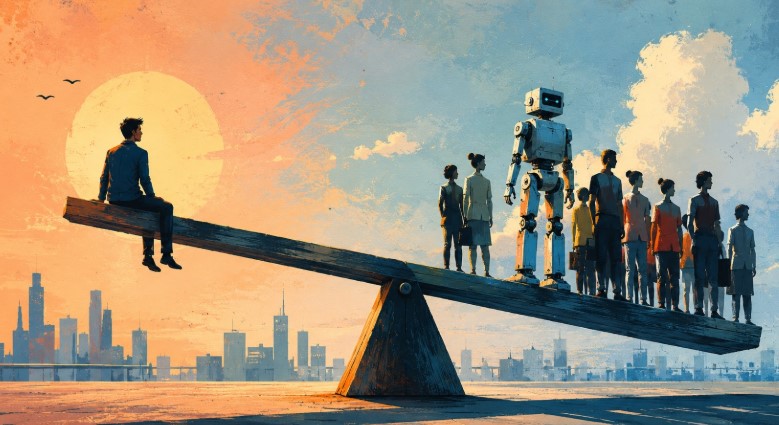
AI does not decide who gets fired. Companies do.
Understanding this distinction is essential for leaders who want to navigate the AI era responsibly.
The Fear of AI and Job Displacement Is Rational
History shows that technological revolutions reshape labor markets. New technologies create opportunities while making certain roles less valuable.
However, AI feels different.
Unlike previous waves of automation that primarily affected physical labor, AI directly impacts knowledge work. Tasks once considered uniquely human can now be performed partially—or sometimes entirely—by machines.
Employees see AI writing reports, generating software code, analyzing data, answering customer inquiries, and producing marketing content. Naturally, they wonder whether their role will be next.
This concern should not be dismissed.
Many organizations are actively exploring ways to reduce costs through automation. Investors reward efficiency gains, and competitive markets push companies to do more with fewer resources.
Yet focusing solely on technology misses a deeper truth.
Technology creates possibilities.
Management decides how those possibilities are used.
AI Is a Tool, Not a Decision-Maker
Artificial intelligence has no objectives of its own.
It does not attend board meetings.
It does not approve budgets.
It does not decide organizational structure.
It does not choose whether productivity gains will benefit employees, customers, shareholders, or executives.
Those decisions remain entirely human.
When an organization adopts AI and reduces headcount, the technology did not make that choice. Leadership did.
Similarly, when an organization uses AI to improve productivity while retaining employees, investing in training, and creating new opportunities, that is also a leadership decision.
The technology remains the same.
The outcome depends on how leaders choose to deploy it.
The Productivity Question
Imagine a team of ten employees.
After implementing AI tools, each employee becomes twice as productive.
Leadership now faces several options:
- Reduce the team size and maintain output.
- Keep the team intact and increase output.
- Reduce working hours while maintaining productivity.
- Reassign employees to higher-value initiatives.
- Invest in innovation and growth.
AI does not determine which option is selected.
Corporate strategy does.
This is why conversations about AI and employment should focus less on the technology itself and more on governance, leadership, and organizational priorities.
The real question is not whether AI increases productivity.
The real question is how the benefits of that productivity are distributed.
A Leadership Test, Not a Technology Test
Every major technological shift eventually becomes a leadership challenge.
The Industrial Revolution introduced machines that dramatically increased production capacity.
The computer revolution transformed office work.
The internet changed communication and commerce.
AI is simply the latest chapter in this ongoing story.
What distinguishes successful organizations is not the technology they acquire but the principles guiding its implementation.
Leaders today face an important choice:
Will AI become primarily a cost-cutting mechanism, or will it become a force multiplier that elevates human potential?
The answer will define workplace culture, employee trust, and long-term organizational resilience.
Why Responsible AI Adoption Matters
Organizations that view AI solely through the lens of headcount reduction may achieve short-term financial gains.
However, they also risk creating long-term problems.
Employees who fear replacement become less engaged.
Innovation declines when people feel disposable.
Trust erodes when productivity gains benefit only a small group of stakeholders.
Meanwhile, organizations that position AI as an augmentation tool often create stronger outcomes.
Employees become more productive.
Teams focus on higher-value work.
Knowledge workers spend less time on repetitive tasks.
Innovation accelerates because people have more capacity for strategic thinking and creativity.
In these environments, AI enhances human capability instead of threatening it.
The Future of AI and Employment
The future of work will not be defined by whether AI replaces humans.
It will be defined by how organizations redesign work around human strengths.
Machines excel at speed, scale, pattern recognition, and automation.
Humans excel at judgment, creativity, empathy, ethics, leadership, and relationship building.
The most successful organizations will not choose between humans and AI.
They will build systems where both complement each other.
This requires investment in reskilling, continuous learning, and organizational adaptability.
Leaders who focus exclusively on cost reduction may overlook these opportunities.
Leaders who focus on value creation will likely discover that AI creates new possibilities rather than simply eliminating jobs.
What Business Leaders Should Fight For
Business leaders have a responsibility that extends beyond quarterly performance metrics.
They influence how technological progress affects employees, communities, and society.
This does not mean resisting innovation.
On the contrary, organizations should embrace AI aggressively where it creates value.
But leaders should also ask difficult questions:
- Who benefits from these productivity gains?
- How can employees participate in the value being created?
- What new opportunities emerge from increased efficiency?
- How can AI strengthen rather than weaken organizational culture?
These questions matter because technology alone does not determine outcomes.
Leadership does.
The Real Question
Public discussions often ask:
“Will AI replace workers?”
That may be the wrong question.
A more useful question is:
How will organizations choose to distribute the benefits created by AI?
If productivity gains are used solely to reduce labor costs, inequality may increase and workforce anxiety will grow.
If those gains are shared through growth, innovation, skills development, and improved working conditions, AI could become one of the most beneficial technologies in modern history.
The future is not being decided by algorithms.
It is being decided by people.
Final Thoughts
AI is transforming business at an unprecedented pace.
Yet it is important to remember that technology itself is neutral.
AI does not decide who gets hired.
AI does not decide who gets promoted.
AI does not decide who gets fired.
Companies do.
As leaders navigate the next decade of technological change, the defining question will not be how powerful AI becomes.
The defining question will be whether leaders use that power to create broader opportunity or deeper inequality.
The future of work depends less on artificial intelligence than on the human decisions surrounding it.